
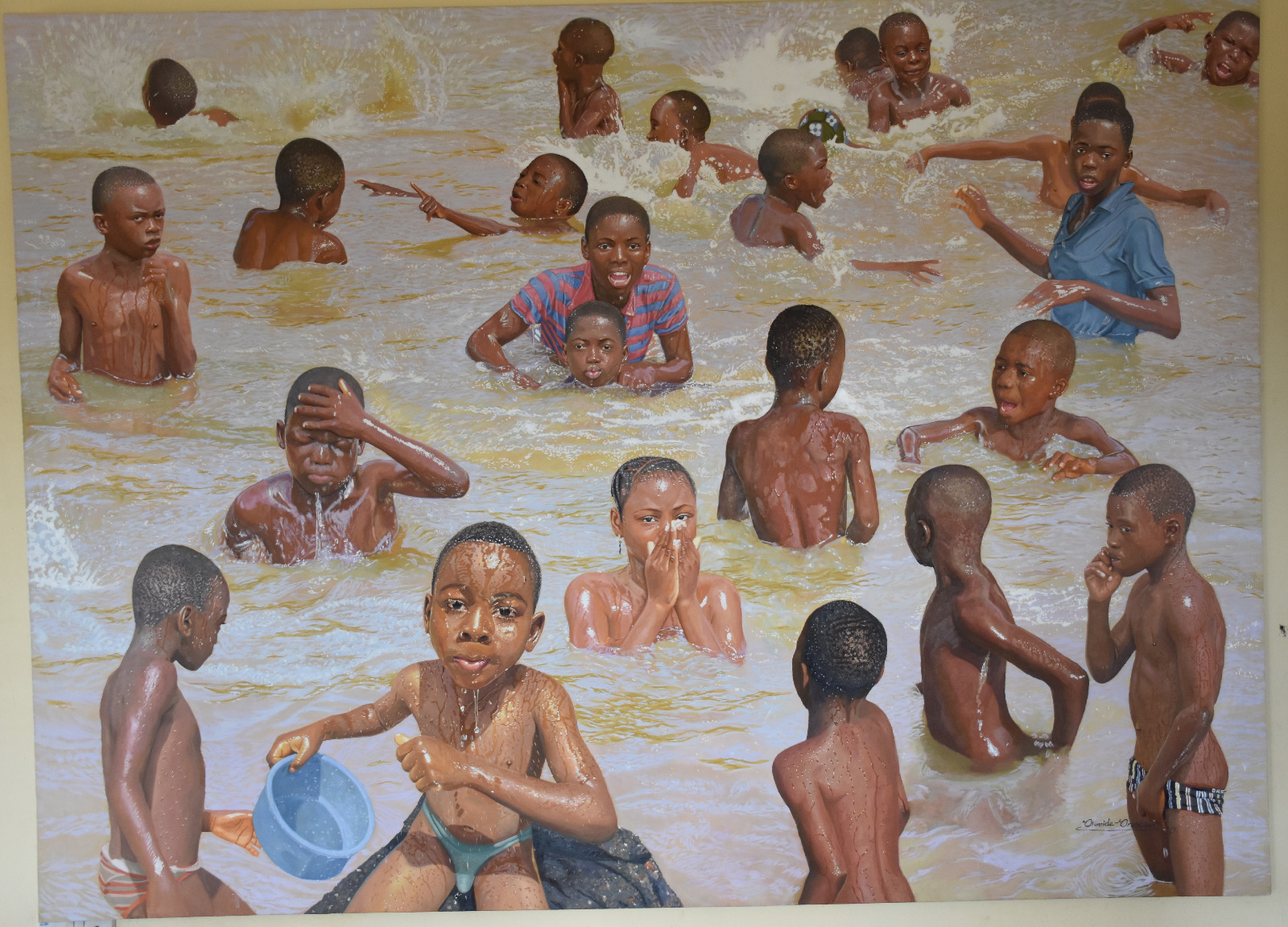
Olumide Oresegun shines as an extraordinary supernova in the dazzling constellation of contemporary African art. His hyperrealist paintings illuminate the canvas with the vibrant pulse of everyday African life. With brushstrokes as precise as a surgeon’s scalpel and an eye for detail that would make a hawk jealous, this extraordinary artist has been weaving visual symphonies that sing the songs of his homeland for over a decade.
Imagine standing before one of his paintings. The laughter of children playing in sun-drenched streets almost reaches your ears. The aroma of spices from a bustling market square nearly tickles your nose. The fabric of a woman’s dress seems to ripple in a breeze you can almost feel. This is the magic of Oresegun’s extraordinary art – a portal that transports you straight into the heart of Africa, no passport required.
New York Art Life had the privilege of sitting down with this extraordinary maestro of the canvas, this alchemist who turns paint into living, breathing snapshots of African life. Let’s dive deep into the world of an artist who doesn’t just paint what he sees – he paints what he feels, what he remembers, what he dreams. This is Olumide Oresegun, an extraordinary artist, and this is his story, painted in words just for you.
Soul of Africa
New York Art Life: Olumide, you’re recognized as one of Africa’s top contemporary painters and truly an extraordinary artist. How does it feel to carry that title, and how has your journey in hyperrealist art evolved over the past 13 years?
Olumide Oresegun: It’s truly humbling to be recognized in this way. When I started my journey in hyperrealism, I was simply pursuing my passion for capturing the beauty and complexity of African life. Over the past 13 years, I’ve seen my work evolve not just in technique, but in depth and meaning. Each painting is a step forward in my quest to portray the soul of Africa through art.
The journey hasn’t always been easy, but it’s been incredibly rewarding. I’ve had to constantly challenge myself, push the boundaries of what I thought was possible with paint and canvas. The recognition is wonderful, but what truly drives me is the ability to share our stories, our culture, and our everyday experiences with the world through my art.
Recent Pieces
New York Art Life: We love your recent pieces! Especially “Metamorphosis of self” and “Harmony”! Can you tell us more about them?
Olumide Oresegun: Thank you! I love those pieces myself! “In ‘Metamorphosis of self’, I wanted to explore the complexity of identity and the constant evolution of the self. The three faces emerging from one represent the various facets of a woman’s personality and her journey through different states of being. Each face is slightly turned, creating a sense of movement and transformation. The woman’s gaze is intentionally proud and direct. I wanted viewers to feel drawn into her presence. To connect with her multifaceted nature. The colorful, patterned headwrap is more than just an accessory – it’s a visual representation of her thoughts, dreams, and the rich tapestry of her inner world.
The high heel at the bottom of the canvas serves a dual purpose. Aesthetically, it grounds the ethereal quality of the portrait in something tangible. Symbolically, it represents femininity and the balance between the spiritual and material aspects of womanhood. Through this piece, I aimed to celebrate the complexity of African womanhood, the beauty of transformation, and the power of self-expression. It’s an invitation for viewers to reflect on their own multifaceted identities and the constant state of becoming we all experience.”
The second painting, “Harmony”, is a tender scene blending the natural world with childhood wonder. A young child cradles a rabbit, their dark skin contrasting beautifully with the animal’s soft fur. The setting suggests a beach with hints of water and sand. Butterflies and a small bird add whimsical touches, while the child’s floral dress echoes the vibrancy of nature. There’s a sense of peaceful coexistence between the human and animal worlds.
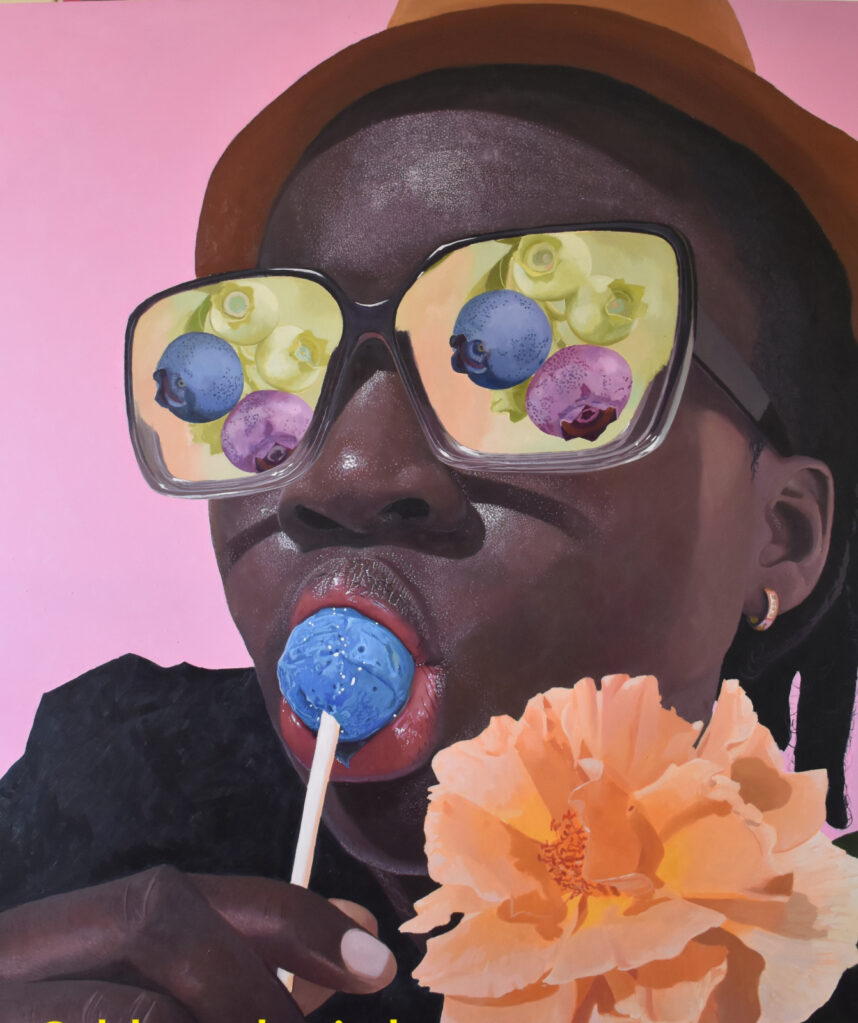
Life In My City
New York Art Life: As an extraordinary artist, your career has been marked by several prestigious awards. Can you tell us about your experience winning the “Life in My City” art competition in 2007 and how it impacted your extraordinary journey?
Olumide Oresegun: Winning the “Life in My City” competition in 2007 was a pivotal moment in my career. It was Nigeria’s most recognized art contest, with over 5000 entries, so the competition was fierce. The theme resonated deeply with me because capturing city life, particularly the vibrant energy of African urban spaces, has always been a passion of mine.
Winning first prize was not just an honor. It was a validation of my artistic vision and technique. It opened doors for me in the Nigerian art scene and beyond. Suddenly, galleries and collectors were taking notice. It gave me the confidence to push further with my hyperrealist style and to tackle more ambitious subjects and compositions.
Don Quixote in Nigeria
New York Art Life: Your extraordinary talent was further recognized when you won the Spanish Embassy’s “Don Quixote in Nigeria” competition in 2009. How did this international recognition, including the trip to Madrid, influence your artistic perspective?
Olumide Oresegun: The “Don Quixote in Nigeria” competition was a fascinating challenge. It required me to blend the iconic Spanish literary figure with Nigerian culture – a perfect opportunity to showcase the universality of human experiences across cultures.
Winning first prize and the trip to Madrid was transformative. It was my first time experiencing European art museums in person. Seeing the works of the Old Masters up close – the attention to detail, the mastery of light and shadow – it was like attending a masterclass in painting. I spent hours in the Prado Museum, studying the techniques of Velázquez and Goya.
This experience broadened my artistic horizons and influenced my approach to hyperrealism. I began to explore how I could incorporate some of the classical techniques I observed into my depictions of contemporary African life. It was a beautiful fusion of old and new, East and West.
Spectrum Miami 2022
New York Art Life: As an extraordinary artist, your participation in the Spectrum Miami 2022 Art Fair was a significant milestone. How did it feel to be a lead artist at one of the USA’s biggest art fairs?
Olumide Oresegun: Being a lead artist at Spectrum Miami 2022 was an exhilarating experience! It’s one of the most prestigious art fairs in the United States, and to have my work showcased there was really a dream come true. The fair attracts art lovers and collectors from all over the world, so it was an incredible platform to share my vision of Africa with a truly global audience.
What struck me most was the response to my work. People were drawn to the hyperrealist details, of course, but what moved them was the stories behind each painting. They wanted to know more about the children I portrayed, about life in African markets, about the traditions and changes in our society. It was gratifying to see my art serving as a bridge between cultures, fostering understanding and appreciation.
The experience also allowed me to interact with other artists from diverse backgrounds. These exchanges exposed me to new perspectives and techniques that continue to influence my work.
African Art Auction in London
New York Art Life: Your extraordinary work has gained significant recognition in the auction world, including at Sotheby’s Contemporary African Art Auction in London. How does it feel to see your paintings alongside other renowned African artists?
Olumide Oresegun: Having my work featured in Sotheby’s Contemporary African Art Auction was a surreal experience. Sotheby’s is one of the most prestigious auction houses in the world, and to see my paintings there, alongside other renowned African artists, was a moment of immense pride not just for me, but for the entire contemporary African art scene.
It’s evidence of the growing global recognition of African art. For too long, African artists have been underrepresented in the international art market. To be part of this change, to see collectors and art enthusiasts from around the world bidding on our work, is incredibly encouraging.
But more than personal recognition, I see it as an opportunity to bring more attention to African narratives. Each painting that sells is a piece of Africa finding a home somewhere in the world.
Haegeumgang Theme Museum
New York Art Life: As an extraordinary artist, your work is now part of museum collections, including the Haegeumgang Theme Museum in South Korea. How important is it for you to have your art represented in different parts of the world?
Olumide Oresegun: Having my work in museum collections around the world, like the Haegeumgang Theme Museum in South Korea, is of utmost importance to me. It’s not just about personal achievement. It’s about cultural exchange and representation.
When a museum in Asia, Europe, or America includes my work in their collection, they’re not just acquiring a painting – they’re bringing a piece of Africa into their space. Visitors to these museums get to experience a slice of African life, to see our world through my eyes. It challenges stereotypes and presents a more nuanced, human view of Africa.
Moreover, it sends a powerful message to young African artists. It shows them that our stories, our perspectives, have a place on the global stage. It encourages them to pursue their art with confidence, knowing that there’s an audience out there eager to engage with African creativity.
Seattle Art Week
New York Art Life: As an extraordinary artist, you’ve played a crucial role in showcasing hyperrealism paintings to North Western American audiences, particularly during the Seattle Art Week. Can you share your experience of introducing your art to new audiences?
Olumide Oresegun: The Seattle Art Week event at TASWIRA gallery was a fantastic opportunity to introduce my work to a new audience. The North Western American art scene is vibrant and diverse, but African hyperrealism was relatively new to many attendees.
What I found most rewarding was the genuine curiosity and openness of the audience. They were eager to understand the stories behind each painting, the symbolism, and the cultural context.
It was also a learning experience for me. I gained insights into how different cultures interpret visual cues, what resonates universally, and what requires more context. This feedback is invaluable and continues to inform my work.
Ultimately, art is about connection, and events like this allow for a deep, meaningful exchange of ideas and perspectives. It’s not just about showcasing my work. It’s about fostering a dialogue between cultures which I think makes the world understand each other better.
American Friends Museum
New York Art Life: Your extraordinary work has been featured in high-profile auctions, including the American Friends of Museum in Israel Fine-Art Benefits Auction. How does it feel to have your art alongside works by artists like Damien Hirst and Tracy Emin?
Olumide Oresegun: Being featured in the American Friends of Museum in Israel Fine-Art Benefits Auction was an incredible honor. To have my work presented alongside artists like Damien Hirst and Tracy Emin, who have shaped contemporary art in profound ways, was both humbling and exciting.
It’s a validation of the power and relevance of African art in the global context. It shows that our voices, our perspectives, are being recognized and valued on the same level as these established Western artists.
But beyond the prestige, what really moves me is the impact. These high-profile auctions bring attention to African art and artists. They create opportunities for collectors to discover new voices and for our stories to reach wider audiences.
Schroders Investment Bank
New York Art Life: As an extraordinary artist, you’ve also contributed to charitable causes through your art, such as fundraising for pancreatic cancer research in the UK. How important is it for you to use your art for social good?
Olumide Oresegun: Using my art for social good is extremely important to me. Art has the power to move people, to raise awareness, and to drive change. When I contributed to the fundraising for pancreatic cancer research through Schroders Investment Bank, helping raise £160,000, it was a reminder of this power.
As artists, we have a platform and a voice. I believe it’s our responsibility to use that voice not just for self-expression, but also to contribute positively to society. Whether it’s raising funds for medical research, bringing attention to social issues, or simply spreading joy and beauty, art can make a real difference in people’s lives.
Moreover, these initiatives often bring art to people who might not typically visit galleries or museums. It’s a way of democratizing art, making it accessible and relevant to a broader audience while supporting important causes.
Inspiration
New York Art Life: Finally, let’s talk about your extraordinary artistic style. Your hyperrealist paintings focus on everyday African life, particularly children and market scenes. What draws you to these subjects, and how do you approach capturing their essence? Are there any artists who particularly inspire you?
Olumide Oresegun: My focus on everyday African life, particularly children and market scenes, stems from a deep desire to capture the beauty, complexity, and vibrancy of our culture. These scenes are the heartbeat of African society – they’re where life happens in all its colorful, chaotic glory.
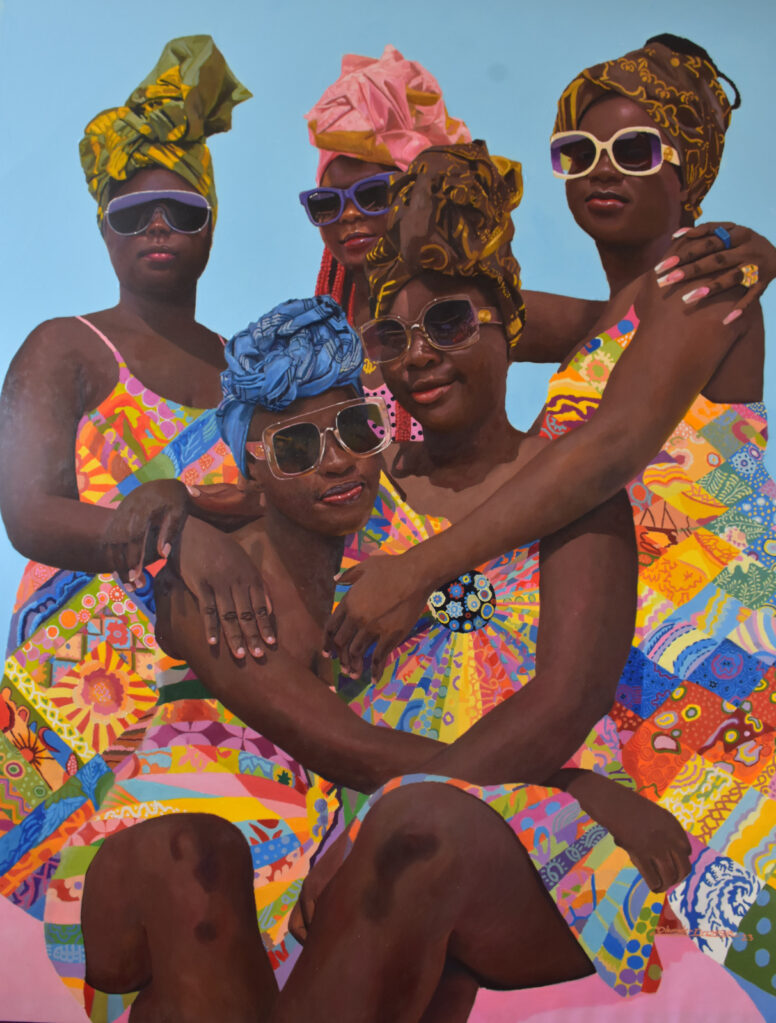
Children, with their innocence and unbridled joy, represent hope and the future. When I paint a child, I’m not just capturing a moment. I’m capturing potential, dreams, and the pure essence of what it means to be human. The market scenes, on the other hand, are a microcosm of our society – the hustle and bustle, the interactions, the traditions, and the gradual changes as modernity seeps in.
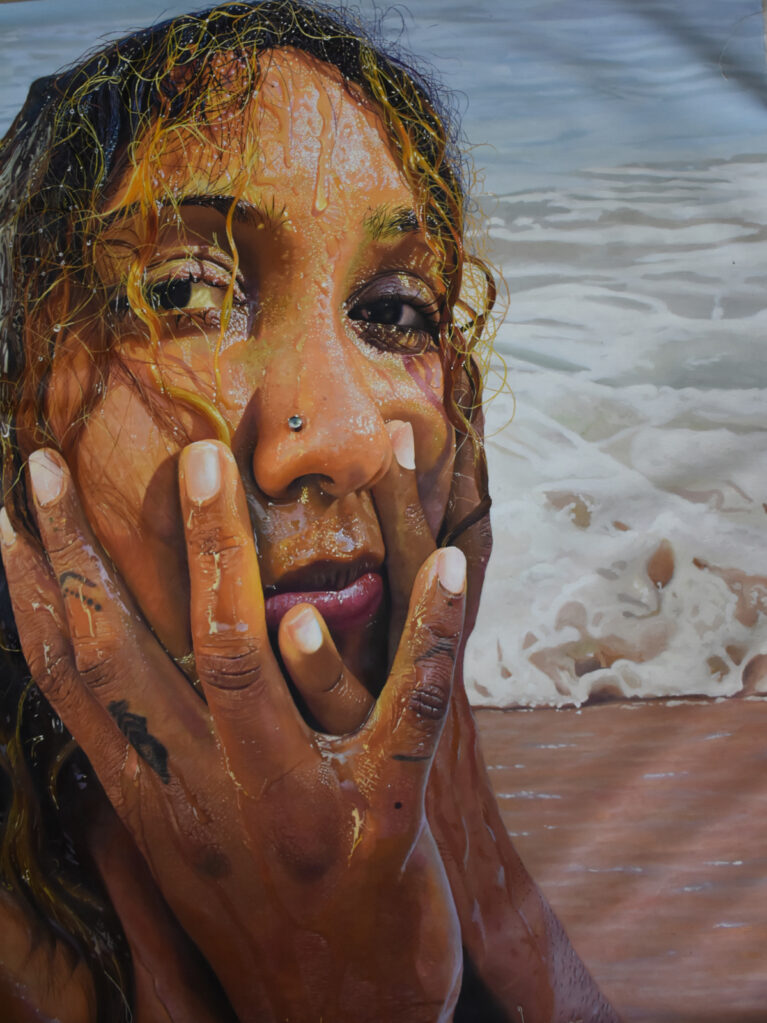
My approach to hyperrealism is meticulous and time-consuming. Each painting involves multiple layers of color application, sometimes taking months to complete. I pay extreme attention to details – the play of light on skin, the texture of fabrics, the expressions in people’s eyes. But beyond the technical aspects, I strive to infuse each piece with emotion and story.
I often spend time observing and sketching in markets or communities before starting a painting. It’s about capturing not just the visual details, but the atmosphere, the energy, the unspoken stories. My goal is for viewers to not just see the painting, but to feel as if they could step into the scene, hear the market chatter, feel the sun on their skin.
Asfor inspiration, I’m deeply influenced by both Nigerian and global artists. Among Nigerian artists, I greatly admire Arinze Stanley Egbengwu for his incredibly detailed pencil drawings and Babajide Olatunji for his powerful “Tribal Marks Series.” Their ability to capture the essence of Nigerian culture and identity in such meticulous detail is truly inspiring.
On the global stage, I’m particularly drawn to the work of Denis Peterson, who is considered one of the pioneers of hyperrealism. His urban scenes and social commentary pieces have greatly influenced my approach to storytelling through art. I’m also inspired by Eloy Morales, especially his self-portraits. The way he manipulates paint to create such lifelike textures is something I constantly strive to emulate and build upon in my own work.
Through this detailed, emotive approach to hyperrealism, and drawing inspiration from these remarkable artists, I hope to challenge stereotypes, celebrate our culture, and invite the world to see Africa through a lens of beauty, dignity, and shared humanity.
Another artist who has significantly influenced me is Argentine painter Helmut Ditsch. His monumental landscape paintings, especially those depicting icy, remote environments, have taught me a lot about capturing light and atmosphere. Ditsch’s ability to convey the raw power and beauty of nature on a grand scale has inspired me to push the boundaries of realism in my own work, particularly in how I portray the interplay between my subjects and their environments.
These diverse influences, both from within Nigeria and around the world, have helped shape my artistic vision and technique, allowing me to create pieces that I hope resonate with viewers on a deep, emotional level.
New York Art Life: Thank you, Olumide, for this insightful conversation. Your extraordinary work truly brings the vibrant spirit of Africa to life on canvas, and we look forward to seeing more of your incredible art in the future. As an extraordinary artist, what final thoughts would you like to share with our readers?
Olumide Oresegun: Thank you for this opportunity to share my journey and my passion! Art is a powerful medium for cultural exchange and understanding, and I’m honored to play a part in bringing African perspectives to the global stage. As an artist striving to create extraordinary work, I’m excited about the future of African art and grateful for platforms like New York Art Life that help bridge cultural gaps through art appreciation. I hope my work continues to inspire and connect people across cultures, reminding us all of our shared humanity!
As our conversation with Olumide Oresegun draws to a close, we find ourselves standing at the edge of a vast, colorful canvas that stretches far beyond the horizon. This canvas, woven from the threads of extraordinary talent and unwavering dedication, is Oresegun’s gift to the world of contemporary art.
In the grand gallery of life, Olumide Oresegun’s work reminds us that in the end, we’re all part of one magnificent, ever-evolving masterpiece – the human experience, painted in the bold, beautiful colors of diversity and understanding.
Follow Olumide here.
Read Also:
The 5 Most Important African American Artists in New York
Top Things to Do in Chelsea NYC: July 2024 Gallery Events

