
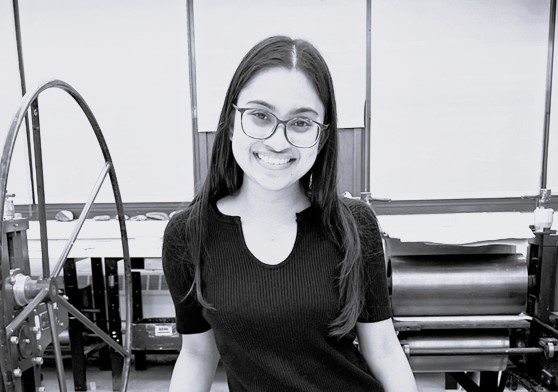
Get ready to be blown away by the incredible talent of Sakshi Doshi, the Boston-based visual artist who is taking the art world by storm. In a recent interview with NY Art Life Magazine, Sakshi shared her fascinating journey as an artist and her innovative exploration of working with cotton muslin, a translucent fabric she discovered during a trip to India. This unique material has become the canvas for Sakshi’s creations, which seem to come alive.
What sets Sakshi apart from other artists is her unconventional art creation process. She breathes life into her works using warm iron and fresh ink, allowing them to evolve and transform before our eyes. It’s as if her pieces have a heartbeat pulsating with energy and vibration. Combining the delicate cotton muslin and the fluidity of the ink results in mesmerizing artworks that capture the essence of movement and change.
Sakshi’s talent stands out from among her peers, as she has had the privilege of showing her works in New York, Boston, and Mumbai exhibitions. Her unique style, characterized by organic grids and the exploration of shapes, forms, and dimensions, has captivated audiences worldwide. Whether through physical exhibitions or virtual platforms, Sakshi’s art has found its way into the hearts of art enthusiasts everywhere.
When viewing Sakshi’s artwork, one cannot help but be drawn into her world. The intricate patterns and textures created by the union of form and aesthetics invite us to explore and lose ourselves in her artistic universe. Each piece tells a story, a narrative that unfolds as we immerse ourselves in the layers and depths of her work. It’s a truly captivating experience that leaves a lasting impression.
Sakshi Doshi has established herself as a trailblazer in the art world through her innovative use of materials and ability to breathe life into her creations. Her works are multidimensional and thought-provoking living entities that evolve and grow with time. It’s no wonder that her art has garnered attention on various online platforms and virtual exhibitions, allowing people from all corners of the globe to experience what she creates.
New York Art Life: You have been fortunate to exhibit your artwork in prestigious galleries worldwide. From the Fresh Faces exhibition at Abigail Ogilvy Gallery in Boston to the Morgan Lehman Gallery in New York with “Into the Thicket,” and from the Piano Craft Gallery in Boston to the Commonwealth Gallery with its exhibition “Traces & Echoes,” your work has reached diverse audiences. You have also showcased your art internationally at venues such as Space 118 in Mumbai and The Space Studio Baroda in Baroda, Gujarat, India. These exhibitions are just a few examples of where your art has been displayed. We are curious to know where you find inspiration and what your driving force is.
Sakshi Doshi: Through exhibitions at various esteemed galleries, I hope to continue sharing my vision with a diverse audience. The driving force behind my creativity lies in the joy I find in discovering intriguing shapes formed by light and shadow. During my explorations, I can truly immerse myself in the beauty of these transient moments. My work focuses on capturing these forms and timestamps in architecture, allowing me to delve deeper into the essence of these fleeting moments. By doing so, I can create art that captures the physicality of these structures and their emotional significance.
I often find comfort and inspiration in specific architectural shapes and forms in my artistic journey. These structures become a sanctuary where I can freely express my emotions. It is within these architectural spaces that I feel a sense of belonging and connection. By immersing myself in these forms’ lines, curves, and angles, I can tap into a wellspring of creativity and inspiration.
Furthermore, architecture itself serves as a powerful source of inspiration for me. The creativity of design, the juxtaposition of different materials and textures, and the harmony of shapes and proportions all contribute to the simplicity and dimensionlaity of architectural design. Observing and analyzing these elements gives me new insights and perspectives that inform my artistic practice.
New York Art Life: How much is your art influenced by Indian culture, and how much has world art been conditioned by Indian art?
Sakshi Doshi: This question allows me to express the significant influence that India’s infinite artistic world has had on the world and the strong influence that has conditioned it. First, architectural in India is characterized by a multifaceted visualization of classical and modern design, and with the beauty of using sustainable materials. For example, in my work, I utilize cotton muslin, a translucent fabric I acquired during a trip to India. My work pushes the boundaries of what visual art is. Can an architecturally inclined visual work be considered architecture? I think my work blurs the lines and is extremely engaging for the viewer.
Indian textiles are renowned for their intricate designs and vibrant colors. India’s rich cultural heritage is reflected in its textile patterns, which have been adapted and incorporated into World fashion, interior design, and decorative arts. The unique blend of traditional techniques and contemporary styles makes Indian textiles highly sought after in the global market.
Second, Indian art is steeped in symbolism and mythology. Each textile design carries a deeper meaning, often rooted in ancient stories and beliefs. These motifs are carefully crafted using traditional techniques that have been passed down through generations. From the intricate block prints of Rajasthan to the delicate silk weaves of Varanasi, Indian textiles tell a story of their own.
Third: The techniques used in traditional Indian art, such as miniature painting, frescoes, and intricate carving, have inspired and influenced World artists for centuries. Indian art’s attention to detail and use of vibrant colors captivate my imagination.
One such artist who was deeply influenced by Indian art is Wassily Kandinsky. Known as one of the pioneers of abstract art, Kandinsky was drawn to the spirituality and philosophy of India. He incorporated elements of Indian art into his abstract compositions, creating a fusion of Eastern and Western artistic styles. His works reflect the influence of Indian art in their use of bold colors and geometric shapes.
New York Art Life: I would like to take this opportunity to discuss your recent artwork, which you have titled “Scaffolding.” This particular art piece can be defined as urban minimalism, drawing substantial inspiration from the lines and geometric forms the renowned artist Piet Mondrian used. In this work, you have sought to capture the essence of urban landscapes by using simple lines and shapes, creating a sense of structure. The influence of Mondrian’s style can be seen in the clean lines that define this artwork, creating a visually striking composition reflecting urban minimalism’s spirit.
Sakshi Doshi: My Artwork “scaffolding” is a unique style that merges the principles of minimalism with urban themes or settings. My art practice is characterized by clean lines, simple forms, and a concentration on essential elements, which mirror the simplicity and functionality often associated with urban environments. I adopt this style to draw inspiration from various aspects of city life, such as cityscapes, architecture, or the rhythm and movement in urban areas.

I like the use of monochromatic color palettes and exploring dimensions. By employing this technique, I emphasize the simplicity and clarity of their compositions. The absence of vibrant colors and intricate details allows the focus to shift towards the fundamental elements of the artwork, creating a sense of visual harmony. This minimalist approach also enhances the overall aesthetic appeal of the piece, giving it a modern and tranquil look.
I like to evoke a sense of calm, order, and serenity amidst the chaos and complexity of city living. The clean lines and simplified forms create a sense of organization and structure, offering viewers a respite from the overwhelming nature of urban environments. The deliberate use of essential elements also encourages contemplation and introspection, inviting viewers to engage with the artwork on a deeper level.
New York Art Life: We are genuinely fascinated by your work, which is made of simple lines and soft colors. What are you working on now? What is your new artistic project?
Sakshi Doshi: In my rigorous exploration of the world of art, I have been captivated by the use of cotton muslin, a delicate and translucent fabric that I acquired during a trip to India. This fabric has become an essential medium for my art practice, as I employ a unique process involving a warm iron and fresh ink to create works that are alive and constantly evolving. The combination of the fabric’s ethereal qualities and the organic transformation brought about by the ink results in pieces that breathe and seem to have a life of their own.
One of the predominant themes in my work is abstractionism, particularly with geometric shapes. I am drawn to the simplicity and purity of these forms, which allow me to explore the interplay between color, line, and space. Through arranging and manipulating geometric shapes, I aim to create a visual language that goes beyond representation and taps into the universal language of emotions and sensations.
Influenced by artists such as Ellsworth Kelly, Kazimir Malevich, Barnett Newman, and Nasreen Mohamedi, I strive to push the boundaries of abstraction and challenge traditional notions of art. These artists have allowed me to experiment with different techniques and concepts, encouraging me to explore new possibilities within my artistic practice. Their bold and innovative approaches have inspired me to embrace experimentation and the unknown, leading to exciting discoveries in my work.
Read Also:
This Week NYAL Interviews Indian Celebrity and Influencer Sakshi Chopra.
Social Media and the Growth of Art:
The Beaty and Necessity of Design: Heer Mandalia

