

This week in NY Art Life, we are thrilled to spotlight a visionary in the architectural world, Aishwarya Pai, whose groundbreaking work is new standards from the vibrant streets of Los Angeles. Aishwarya’s portfolio is a kaleidoscope of innovation and elegance, embracing everything from affordable housing and institutional design to the luxury of single-family residences and the bustling world of hospitality and commercial projects. What truly sets her apart is her unwavering commitment to community-focused design and sustainability, principles that she weaves into every project with meticulous care and profound understanding.
Aishwarya Pai’s design philosophy is nothing short of revolutionary. She aims not just to create buildings but to craft experiences to forge spaces that resonate on a deeply personal level while fostering connections among those who inhabit them. This philosophy breathes life into her work, transforming steel and concrete structures into vibrant communities. Her approach is an inspiring reminder that architecture goes beyond physical spaces—it shapes our interactions, memories, and way of being in the world.
New York Art Life Magazine: Among your numerous innovative projects, one that stands out as a beacon of futuristic design is the Station Destination—a transportation hub reimagined as a pulsating public space. This isn’t just any project; it’s an architectural symphony designed to facilitate social interaction and community engagement. The Station Destination breaks down literally and metaphorically barriers, creating a space where journeys begin, paths cross, and stories unfold. It’s a testament to your visionary talent for seeing beyond the blueprint and understanding architecture as an instrument of social harmony and connectivity.
Aishwarya Pai: In a world increasingly focused on sustainability and community. My work is a clarion call for architects to think bigger and design with heart and responsibility. My projects are merely structures; they are spaces that breathe, that invite us in not just to see but to experience—to live differently, more fully, and more connectedly. The station and the train serve as essential hubs for people from all walks of life, bringing together individuals of different conditions and backgrounds.
These shared spaces compel people to interact and coexist, creating opportunities for social interaction and connection. Public transport, such as trains and stations, offers a unique setting where individuals can come together and engage in conversations, fostering a sense of community and understanding among diverse groups. It is through these interactions that we can learn from one another and gain a better understanding of the world around us. Investing in and prioritizing public transportation can encourage social interaction and connection and contribute to a more sustainable and inclusive city. The station and the train can become more than just places of transit; they can become spaces where individuals from different backgrounds come together to create a more vital and vibrant community.
New York Art Life Magazine: Your collaboration between Anshia Badyal and Alex Tucciarone of Volunteers of America, Los Angeles (VOALA) has produced an incredible, ingenious, and valuable project for society’s most needy. One project involved building a residential community of 40 single-family homes on a mere acre of land, which is not just an architectural feat but a beacon of hope for many.
Aishwarya Pai: This innovative housing solution is designed with the dual aims of cost-effectiveness and efficiency. It ensures that the project is financially viable while providing much-needed shelter to the homeless population. Including a community area within this compact space further emphasizes the holistic.
Creativity played a pivotal role in this project regarding architectural design and how it tackles the broader issue of homelessness by thinking outside the conventional paradigms of housing development. We crafted a model that can be replicated in other urban areas facing similar challenges. The compact design of single-family homes allows for efficient use of space without compromising on the dignity or privacy of the inhabitants, demonstrating that humane solutions to homelessness are possible even within the constraints of urban environments.
This initiative exemplifies how architects, nonprofit organizations, and communities can create sustainable and dignified solutions to societal issues. It addresses the immediate needs of Los Angeles’s homeless population and sets a precedent for future projects to alleviate urban homelessness through creativity, efficiency, and collective effort.
New York Art Life Magazine: We admire your approach to design, which consistently focuses on addressing real problems faced by the most needy and the most fragile segments of society. Your dedication to creating meaningful, impactful solutions is genuinely commendable. In a similar vein, your recent project concerning children exemplifies this ethos splendidly. The playground ‘Project Replay’ you built at a government school in Bangalore is not only innovative but also deeply thoughtful. Utilizing recycled materials, you have constructed a space that not only encourages physical activity but also fosters creativity and learning among young minds. The play equipment, which includes a tire jungle gym, a rope bridge, and a rope ladder with a blackboard set, serves as a testament to your commitment to sustainability and community enhancement.
Aishwarya Pai: This playground project, ‘Project Replay,’ is particularly noteworthy for its cost-effectiveness. In an era where budget constraints often limit the scope of educational and recreational facilities in public institutions, our design stands out as a beacon of resourcefulness. By employing recycled materials, you have not only reduced costs but also made an environmentally conscious choice that sets a powerful example for the community. The inclusion of versatile play equipment like the tire jungle gym and the rope bridge ensures that children have access to diverse forms of physical exercise, which is crucial for their holistic development.
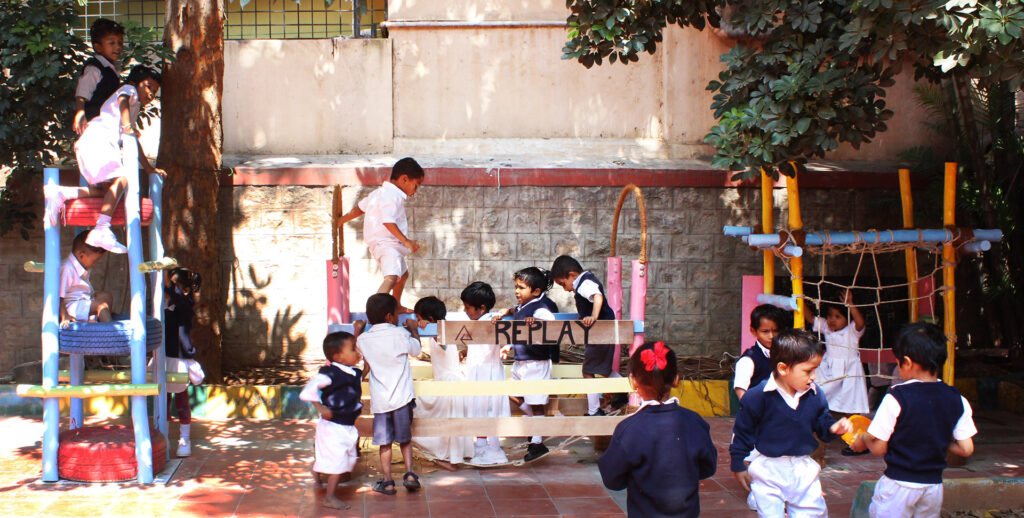
Moreover, the collaborative nature of the project adds another layer of significance. Created in partnership with two other talented artists, the playground is a product of collective creativity and shared vision. This collaboration highlights the importance of teamwork in achieving greater societal good. Each element of the playground, from the rope ladder to the blackboard set, reflects a blend of artistic ingenuity and practical utility, making it a space where children can learn, play, and grow in a safe and stimulating environment.
New York Art Life Magazine: How much influence has your Indian culture had on your creative inspiration? What is the architectural philosophy that you bring to your projects? How has Indian architecture influenced the world of design?
Aishwarya Pai: Growing up in a country with an incredibly diverse heritage, a rich tapestry of history, and a vibrant spectrum of art forms has indelibly shaped my approach to architecture and design. I deeply root the architectural philosophy I bring to each of my projects in this cultural milieu, drawing from the intricate patterns of Indian art, the organic forms found in our natural landscapes, and the principles of Vastu Shastra, which emphasize harmony with nature. This philosophy centers on creating spaces that not only please aesthetically but also deeply connect to their cultural and environmental contexts, promoting sustainability and well-being.
Indian culture, with its emphasis on community, spirituality, and connection to nature, has shaped my perspective on how spaces can influence and enhance human interactions. My designs often incorporate elements such as courtyards, which have been a staple in Indian architecture for centuries, serving as communal spaces that foster social connections while also facilitating natural cooling. Similarly, the use of local materials and traditional craftsmanship is a hallmark of my projects, reflecting a commitment to sustainable practices and a deep respect for the artisanal heritage of India.
As an Indian architect, I find the global influence of these cultural and philosophical underpinnings both humbling and significant. The world of design is increasingly recognizing the value of incorporating sustainable practices and a deeper connection to cultural roots. My work, which marries modern design principles with traditional Indian concepts, has been part of this broader conversation, contributing to a growing appreciation for designs that are both forward-looking and deeply rooted in cultural heritage. This cross-pollination of ideas has not only broadened the scope of my own practice but has also positioned Indian architectural philosophy as a valuable contributor to the global dialogue on sustainable and culturally resonant design. In this sense, the influence of Indian culture extends beyond my individual projects, contributing to a richer, more diverse global design landscape.
New York Art Life Magazine: What advice do you give young architects?
Aishwarya Pai: Embarking on a career in architecture is an exciting and challenging journey, filled with opportunities for creativity, innovation, and impact. Remember, architects do not create architecture in isolation but through the collective effort of various disciplines coming together.
Don’t be afraid to embrace failure as part of the learning process. Each project comes with its set of challenges and setbacks, but it’s through these experiences that you grow and refine your problem-solving skills. Always prioritize the human aspect of your designs. At its core, architecture is about creating spaces that enhance the quality of life for the people who use them. Keeping this perspective at the forefront of your work will guide you towards meaningful and impactful designs.
New York Art Life Magazine: Ah, the grand transition from sun-kissed Los Angeles to the bustling, never-sleeping streets of New York City seems inevitable for someone with your eclectic mix of talent and global vision, peppered with the rich flavors of Indian culture.
Aishwarya Pai: Honestly, who can resist the allure of having their work hailed in a city that’s a melting pot of dreams? Not me
Read Also:
Architecture&Art. Interview with Lucia Dudorova
Experience the Brooklyn Skyline: 5 Iconic NYC Architectural Wonders You Can’t Miss

